- AI ad disclosure laws are live in New York (since June 9, 2026) and start in Pennsylvania on December 21, 2026 and in California on January 1, 2027.
- Pennsylvania (SB 806, Act No. 2026-99): AI content that could create a false impression of the product must state that “the advertisement contains content that was modified or generated using AI.”
- California (SB 1050, Business and Professions Code §17610): a prominent, realistic AI performer needs wording substantially similar to “this performance features a synthetic performer” or “no human performer is depicted.” National ads shown in California are covered.
- New York (S 8420-A): ads with AI-generated synthetic performers must disclose them. Fines are $1,000 for a first violation and $5,000 after that.
- None of the three bans AI in advertising. They require transparency.
- Holiday flights that run past December 21 need their disclosure versions planned now.
AI ad disclosure laws are now in force or about to start in three US states: New York since June 9, 2026, Pennsylvania from December 21, 2026 and California from January 1, 2027. None of them bans AI in advertising. Each one asks for a clear label in specific cases, and the cases differ, so a national campaign has to meet the strictest rule that applies where it runs.
This article is general information, not legal advice. Talk to your counsel about your specific campaigns.
Which US states require disclosures on AI-generated ads?
New York already does, Pennsylvania follows on December 21, 2026 and California on January 1, 2027. The three laws side by side:
| State | Law | In force | What triggers it | Required wording |
|---|---|---|---|---|
| New York | S 8420-A / A 8887-B | June 9, 2026 | AI-generated synthetic performers in commercial ads | A conspicuous disclosure of the synthetic performer |
| Pennsylvania | SB 806 / Act No. 2026-99 | Dec 21, 2026 | Content generated or significantly modified by AI that could create a false perception of the product | “the advertisement contains content that was modified or generated using AI” |
| California | SB 1050 / B&P Code §17610 | Jan 1, 2027 | A prominent, realistic AI performer (image or voice) | Substantially similar to “this performance features a synthetic performer” or “no human performer is depicted” |
What does Pennsylvania’s AI Deceptive Advertising Act say?
It requires a “clear and conspicuous” disclosure on ads that use synthetic content, meaning media significantly modified or generated by AI, “in a manner that creates a false consumer perception” about the nature, origin or authenticity of the product or service. Governor Josh Shapiro signed SB 806 on October 22, 2026, and it takes effect on December 21, 2026.
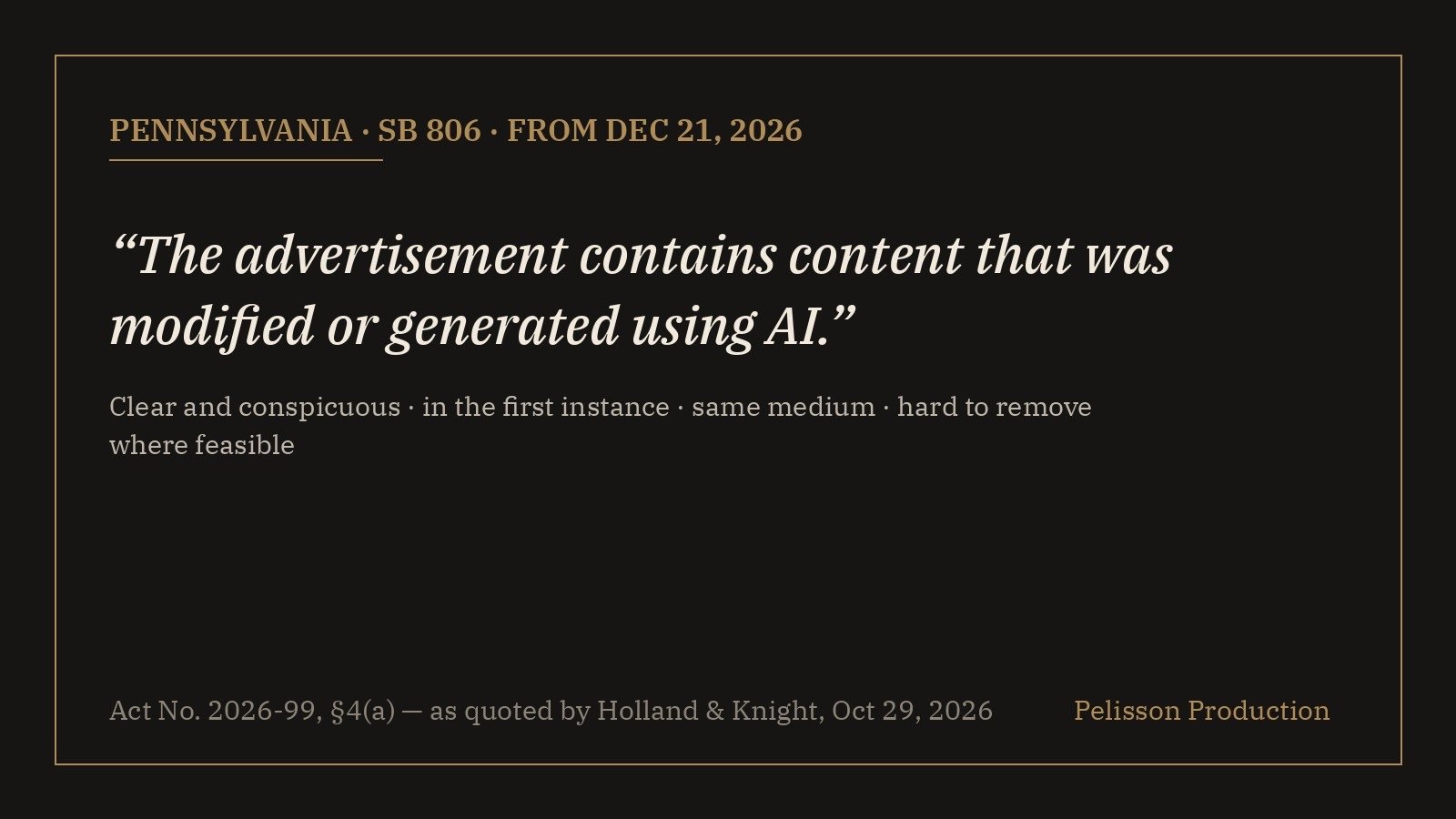
The required statement, per Section 4(a) as quoted by Holland & Knight:
“the advertisement contains content that was modified or generated using AI”
The disclosure must be:
- displayed “in the first instance” whenever the synthetic content is presented, not only on the end card;
- presented in the same medium as the synthetic content: on screen for video, spoken for audio;
- to the extent technically feasible, “permanent or extraordinarily difficult to remove”.
Section 3 defines “clear and conspicuous” as “in a size, color, contrast, location, duration and audibility that is readily noticeable, readable, and understandable and capable of being heard.” Audio must be “delivered in a volume and cadence sufficient for a consumer to hear and comprehend”; on screen, the statement must be “of a size and shade and appear[] on the screen for a duration sufficient for a consumer to read and comprehend” it. It must also be in the consumer’s language, must not contradict the rest of the ad and must sit near the content it explains. No fine print, and no rushed voice-over at the end.
Exceptions (Section 4(b)). Content that is evidently fictional from its content or context; parody, satire, commentary or criticism; and content limited to text.
A label is not a shield (Section 4(c)). “Making the required disclosure is not a defense to any other recourse permitted under the law.” An ad that is otherwise misleading still falls under Pennsylvania’s consumer protection law, which does allow private suits.
Enforcement (Section 5). Only the Attorney General or the appropriate district attorney can enforce the Act, with injunctions and civil fines of up to $3,000 plus attorneys’ fees and court costs. The Act itself gives no private right of action. An intent requirement (“knowingly, recklessly, or willfully”) was struck from the final text, there is no warning or cure period, and the Act does not say whether the cap applies per ad, per airing or per day.
Still open. What counts as a “false consumer perception”, what “significantly modified” means and who exactly the “advertiser” is. Holland & Knight notes that the “cause to be created and disseminated” wording “could reach others involved in preparing and publishing an advertisement”, which may include agencies and production studios.
What does California SB 1050 require for synthetic performers?
From January 1, 2027, ads disseminated in California that prominently feature a realistic AI-generated performer must carry a clear and conspicuous disclosure worded substantially like “this performance features a synthetic performer” or “no human performer is depicted.” SB 1050 was enacted on September 16, 2026 and adds Section 17610 to the Business and Professions Code.
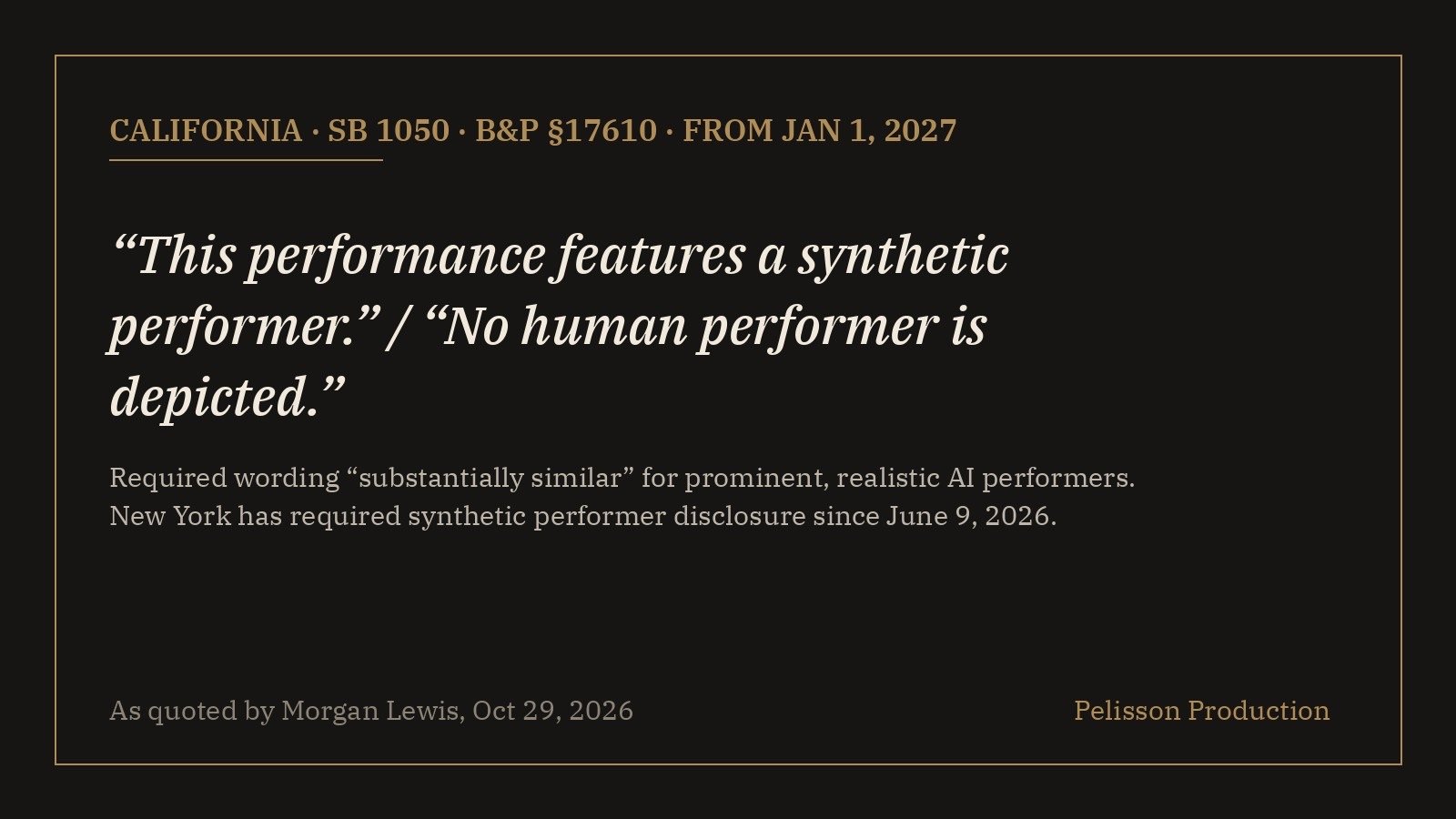
The key terms, as Morgan Lewis summarises them:
- Synthetic performer: “a digital figure, voice, or representation created—in whole or in part—using generative AI that creates the realistic impression of a human audio, audiovisual, or visual performance, but is not recognizable as an identifiable natural person.”
- Prominent: a performance that “(1) appears in the foreground demonstrating or illustrating a product or service; (2) provides narration or the commercial message; or (3) illustrates or reacts to any narration or message.”
- The standard: the disclosure must “be difficult to miss and easily understandable, in a format that a reasonable consumer would notice, read, and comprehend in context.”
Other points:
- National ads are covered if they air or are otherwise disseminated in California, including nationally syndicated ads.
- Exempt: ads for expressive works (films, series, streaming content, documentaries, video games) that use the performer as the work does, and AI used solely to translate a human performer’s language or for accessibility.
- The law sets no placement, duration or format. The safe move is to use one of the two statutory phrases word for word.
- A violation counts as false advertising under §17500 and can be pursued under the unfair competition framework (§17200). After a court order, platforms must stop running the ad in California.
- Real, identifiable people are covered separately by California’s right-of-publicity laws.
Is New York’s AI performer law already in force?
Yes. Since June 9, 2026, New York has required advertisers to disclose AI-generated synthetic performers in commercial ads (S 8420-A / A 8887-B). Fines are $1,000 for a first violation and $5,000 for each one after that (Cooley). California’s law follows New York’s; Pennsylvania’s goes further and covers any AI content that could mislead about the product, not only performers.
Do these laws ban AI in advertising?
No. They require transparency, not abstinence. In Morgan Lewis’s words, the California law “does not generally prohibit synthetic content; it requires disclosure in commercial advertising contexts.” Pennsylvania asks for a label where AI could mislead about the product. AI commercials stay fully on the table. What changes is how they are planned, documented and finished.
What should brands document when they make AI ads?
A shot-by-shot record of what is real, what is AI-generated and what was modified with AI, plus the disclosure decision for each market. Morgan Lewis advises keeping documentation of “the AI tools used, disclosure decisions, and final creative assets, including whether AI-generated performances are recognizable as identifiable persons.”
A good production record answers five questions:
- Which shots are synthetic: generated, significantly modified or filmed?
- Does any AI shot show the product, and does it show what the product really does, looks like and is made of?
- Are there AI people or voices? Are they realistic, and do they demonstrate, narrate or react (California’s “prominent” test)?
- Which label applies where: the Pennsylvania wording, the California and New York wording, both, or none with the reason written down?
- Which master ran where, by market and platform, with dates?
When creative direction plans each frame before anything is generated, this record almost writes itself: you already know what is synthetic, where the product appears and where the label has to sit.
How do you add an AI disclosure without hurting the ad?
Design it into the frame from day one: a fixed text layer in the brand’s typeface, sized and timed to be read, present from the first synthetic shot, plus a spoken line when the medium is audio.
- Set it like a brand element. A legible lower third in your own typeface reads as intentional. We build these in motion design, never in generation, so the wording is exact.
- Plan safe zones per format. In 16:9, 9:16 and 1:1 the line has to stay readable and clear of each platform’s buttons.
- Version by market: one national master with the strictest wording, or separate cuts for Pennsylvania and for California and New York.
- Burn it in. Pennsylvania wants labels that are hard to remove where feasible, so text inside the video beats relying on a platform’s own AI tag.
- Keep it calm. A well-set label says the brand has nothing to hide.
What should brands check before Black Friday and Christmas?
Audit every live and planned AI asset against New York (now), Pennsylvania (December 21) and California (January 1), and lock the disclosure versions before trafficking.
- List every asset that uses AI imagery, video, voice or digital people.
- Check how the product is shown. If an AI shot makes it do something it can’t, fix the creative first: a label won’t save it.
- Flag synthetic performers who demonstrate, narrate or react. They need the California and New York wording.
- Check run dates. Flights that cross December 21 (Pennsylvania) or January 1 (California) need compliant versions from day one.
- Pick the wording. Pennsylvania: “This advertisement contains content that was modified or generated using AI.” California and New York: “This performance features a synthetic performer.” or “No human performer is depicted.”
- Design and test the label in every format: connected TV, YouTube, vertical social and audio.
- Keep the production record described above.
- Add AI disclosure review to approvals and vendor contracts.
- Tell media partners which cut runs where.
- Get counsel’s sign-off on the edge cases, such as “evidently fictional” or “significantly modified”.
How does Pelisson Production handle AI disclosure?
We direct every frame, keep a shot-by-shot log of which tools touched what, and deliver disclosure-ready versions designed as part of the ad, not stuck on at the end. Pelisson Production is an AI video and motion design studio in Málaga, Spain, working with brands in Europe and the US, and several of the AI spots we produced have aired on US television. For a US campaign that means:
- a production log of AI tools and synthetic shots for your legal team;
- disclosure layers in your brand’s typeface, tested in every format;
- market versions (national, Pennsylvania, California and New York) made alongside the master;
- product shots that show what your product really does.
Planning AI commercials for the holidays or Q1? See our work, how we keep AI brand-safe and what our AI video ads include, or book a call.
Sources
- Holland & Knight, “Did AI Touch Your Ad? Pennsylvania May Require You to Say So” (October 29, 2026)
- Morgan Lewis, “California Requires Disclosures for AI-Generated Performers in Advertising” (October 29, 2026)
- New York State Senate, bill S8420-A (2025)
- Cooley, “New York Enacts Synthetic Performer Disclosure Law for Advertisements” (January 29, 2026)
This article is general information only and is not legal advice.
Frequently asked questions
Do I need an AI disclosure on every AI-assisted ad in Pennsylvania?
Not necessarily. The Act targets content generated or significantly modified by AI and used in a way that could create a false consumer perception about the nature, origin or authenticity of the product. Evidently fictional content, parody, satire, commentary, criticism and text-only content are exempt. The key terms are undefined, so many brands will label by default.
What exact wording does Pennsylvania require?
The disclosure must state that “the advertisement contains content that was modified or generated using AI”, shown in the first instance, in the same medium, clearly and conspicuously, and hard to remove where technically feasible.
When do the AI ad disclosure laws take effect?
New York: June 9, 2026 (already in force). Pennsylvania: December 21, 2026. California: January 1, 2027.
Does California’s law apply to national campaigns?
Yes. SB 1050 covers ads that air or are otherwise disseminated in California, including nationally syndicated ads.
What are the fines?
Pennsylvania: civil fines of up to $3,000 plus attorneys’ fees and court costs, enforced by the Attorney General or district attorneys, with no intent requirement and no cure period. New York: $1,000 for a first violation and $5,000 for each one after that. In California a violation counts as false advertising under existing law.
Do these laws ban AI-generated commercials?
No. They require transparency. AI commercials remain legal; they need a clear label where these laws apply.