- Grok Imagine’s Odyssey is a series of short AI-made episodes, not a feature film. Episode 1, “The Oath”, runs about seven minutes and came out on X on October 23, 2026.
- It was made with Wonder Studios, a London start-up, and director Dev Walker: a team of three in under two weeks, reportedly for tens of thousands of dollars.
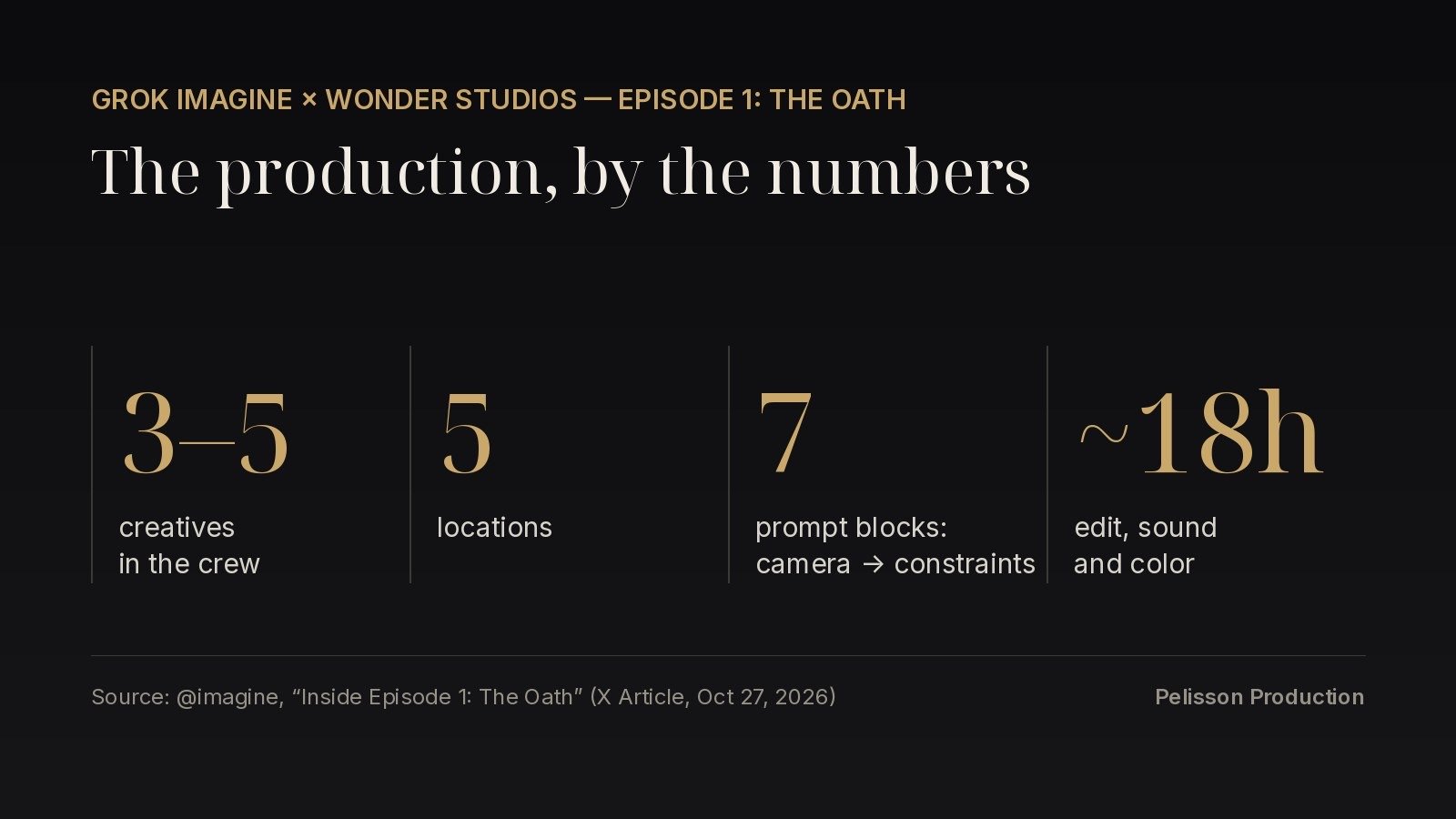
- On October 27 the team published its workflow: a shot list, character sheets, five fixed locations, keyframes, video prompts in seven blocks and about 18 hours of edit, sound and colour.
- Critics were harsh: TechCrunch called it “airless”, the Guardian’s reviewer gave it one star, and Grok itself told Wired it is not historically accurate.
- For brands, the news is the method, not the film. It is the same discipline good AI video ads need: write first, lock the look, then edit by hand.
Grok Imagine’s Odyssey is a series of short AI-made episodes, not the full-length film Elon Musk promised: Episode 1, “The Oath”, about seven minutes long, went out on X on October 23, 2026 (@imagine). Four days later the team published exactly how they made it. That workflow, more than the episode, is what anyone making AI video ads should read.
| Episode 1, “The Oath” | |
|---|---|
| Released | October 23, 2026, on the @imagine account on X; more than 8 million views by early November |
| Length | About seven minutes |
| Made by | Grok Imagine with Wonder Studios, a London start-up, and director Dev Walker |
| Story | A scene from the Cypria, the lost prequel to the Iliad: Odysseus fakes madness to escape the Trojan War, and is found out |
| Team and time | A creative team of three in under two weeks, according to Wonder’s co-founder; the workflow article speaks of a crew of 3–5 |
| Cost | Reportedly tens of thousands of dollars, against $250m for Christopher Nolan’s The Odyssey (the Guardian) |
Is Elon Musk’s AI Odyssey a full movie?
No. It is being released as short episodes made for social media. Three months earlier Musk had said Grok would make a full-length, “historically accurate” version of The Odyssey (TechCrunch); the Guardian notes he had promised a “full-length movie” before the end of the year and is now sticking to episodes (the Guardian). The team says episodes were planned at about five minutes and will get more runtime, while staying short.
What workflow did Grok Imagine publish?
A twelve-step method from script to final edit, published on October 27, 2026 as “Inside Episode 1: The Oath”. Its stated goal is honest, critical feedback from filmmakers to improve Grok Imagine’s image and video models; Wonder Studios shared it too. In short:
| Step | What they did |
|---|---|
| 1. Script | Started from the brief summary that survives of the Cypria and invented the rest: dialogue, scenes, faces. |
| 2. Shot list | Before generating anything: shot size, lens, camera move, action and exact dialogue for every shot, with folders named by scene and A- or B-roll. |
| 3. Canvas | Every frame, prompt and take on one Grok Imagine canvas, grouped by shot, so takes can be compared for faces, wardrobe and light. |
| 4. Character sheets | A close-up, a full front and a full back on plain grey. A new sheet when a character ages or changes costume: Odysseus has three. |
| 5. Character prompt | One fixed description per character to keep the face the same. They admit it still drifts now and then. |
| 6. Locations | Five: the field, the palace, the shore, the ship and the camp outside Troy. Every prompt names shot size, time of day, mood, camera, lens and film stock. |
| 7. One look | A mood board, then the same camera, lens and film stock in every prompt. No director named: the look is described as early-2000s period epics. |
| 8. Keyframes | The character placed in each location as a still first. If the still is wrong, the video will be too. |
| 9. Video prompts | Seven blocks: camera, action, environment, physics, audio, SFX, constraints. If a prompt fails, make it shorter. |
| 10. Middle keyframes | A frame between start and end, timed exactly, used to make Odysseus enter on cue with a plough. |
| 11. Camera | Written into every prompt: a static camera to set the scene, handheld once the fighting starts. |
| 12. Edit | About 18 hours of editing, sound and colour. Most sound effects came from Grok Imagine; music and the grade went on top. |
What is the 7-block video prompt structure?
Every video prompt is written in the same seven labelled blocks, always in the same order, so shots are comparable and easy to revise. In our words, this is what goes in each:
- Camera and style: format, lens, film look, frame rate and whether the camera moves at all.
- Action: who does what, where in the frame, from the first frame to the last.
- Environment: location, weather, light and atmosphere.
- Physics: how weight, cloth, liquids or wind should behave.
- Audio: the sound bed, and whether there is music or dialogue.
- SFX: the specific sound effects in the shot.
- Constraints: what must not happen: no cuts, no camera drift, who stays where.
For an ad, the same structure fits a 6-second product shot as well as an epic: one block for the lens and light, one for the hand that opens the bottle, one for the condensation on the glass, one for the pour you want to hear, and a constraints block that keeps the label straight and readable.
What did critics say about the Grok Odyssey?
Mostly harsh, with a few concessions on individual shots.
- TechCrunch (October 25, Anthony Ha) said some moments could pass for real actors on a real sea, but found the whole “airless”.
- The Guardian (October 27) reported that its critic gave it one star and called it “meaningless as a laptop screensaver”. Wonder said the next episode would address the historical accuracy of the boats and the rapid pacing.
- Wired (October 26) reported that Grok itself says its version is “not historically accurate”.
- Variety (October 25) covered the release as a partial follow-through on the feature-length promise.
Notice what the criticism is about: story, pacing and period detail, not resolution. Those are direction and editing problems, which is exactly where the work in an AI production goes.
What should brands copy for AI video ads, and what should they skip?
Copy the process, skip the promise. Seven minutes of epic is a different job from a 15- or 30-second commercial, but the craft problems are the same.
Copy:
- Write the script and the shot list before the first prompt. In an ad, that means one message, a scene list and timings.
- Lock your locations and reuse them. A fixed store, kitchen or studio keeps a campaign coherent across cuts.
- Make a reference sheet for the presenter or the product in every state it appears: new outfit, new sheet.
- Get the keyframe right before you animate. A still is cheap to fix; a generated shot is not.
- Use one prompt structure for every shot, and shorten a prompt that fails instead of adding words.
- Describe the look instead of naming a director. It is cleaner creatively and safer for a brand.
- Budget a real edit. Eighteen hours for seven minutes is the honest part: generation gives you material, the edit makes the film.
Skip:
- Promises you cannot show yet. “Feature film” became “Episode 1”; with clients, show tests early.
- Accuracy claims about the world. In an ad, the accuracy that matters is the product’s.
- Running out of story before runtime. Short formats need a strong idea even more.
One more thing for US campaigns: a realistic AI person like this Odysseus in an ad is a “synthetic performer”, and New York already requires a label for it, with California and Pennsylvania following. See our guide to AI ad disclosure laws in the US.
How does Pelisson Production make AI video ads?
The same way: script and shot list first, look-frames and character references locked before generation, every frame directed, and the edit, colour and sound finished by hand. Pelisson Production is an AI video and motion design studio in Málaga, Spain, working with brands in Europe and the US, and several of the AI spots we produced have aired on US television. See how we work, our work and what our AI video ads include, or book a call.
Sources
- Grok Imagine (@imagine), Episode 1 of the Odyssey series, X, October 23, 2026
- Grok Imagine (@imagine), “Inside Episode 1: The Oath”, X article, October 27, 2026
- Wonder Studios (@WonderStudiosX), post sharing the workflow, X
- TechCrunch, Anthony Ha, “Grok releases the first seven minutes of its AI-generated ‘Odyssey’”, October 25, 2026
- The Guardian, Dan Milmo, “Meaningless as a laptop screensaver: reviewers slate Musk’s AI-made Odyssey film”, October 27, 2026
- Wired, Miles Klee, “Grok says its AI-generated version of The Odyssey is ‘not historically accurate’”, October 26, 2026
- Variety, Payton Turkeltaub, October 25, 2026
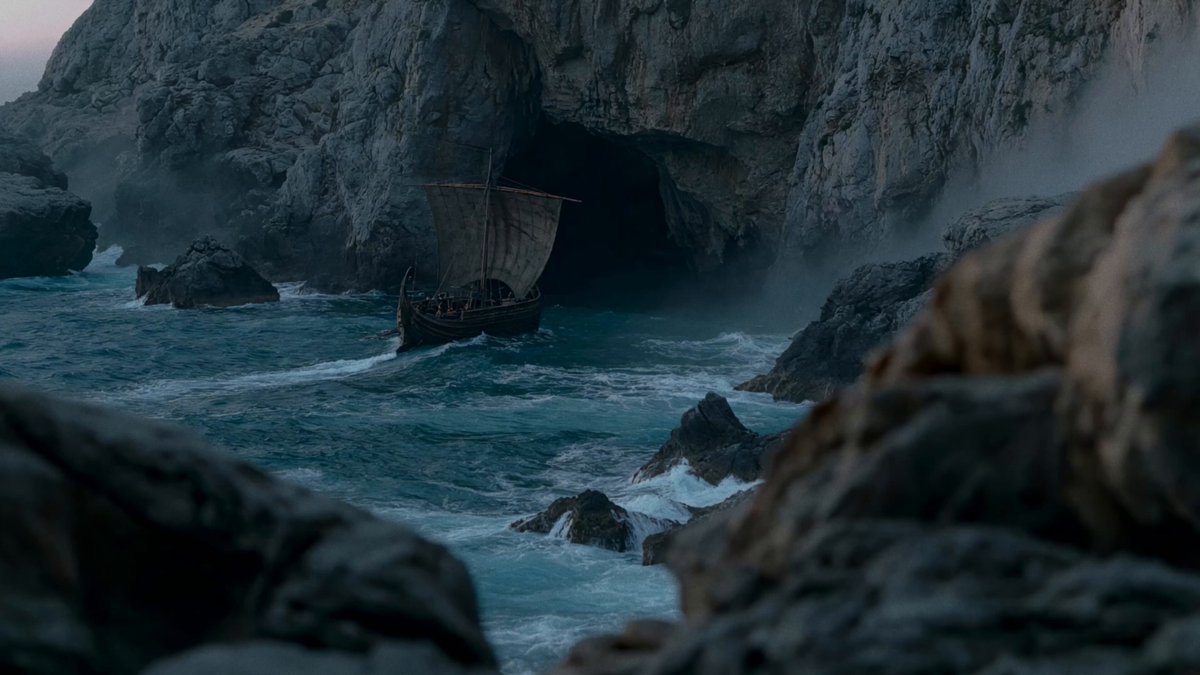
Pelisson Production is not affiliated with xAI, Grok Imagine or Wonder Studios. The cover frame comes from the episode itself and is shown for commentary.
Frequently asked questions
Is Grok Imagine’s Odyssey a full movie?
No. What came out on October 23, 2026 is Episode 1, “The Oath”, a short of about seven minutes, the first of a series of short episodes. Elon Musk had promised a full-length film by the end of the year.
Who made the AI Odyssey episode?
Grok Imagine with Wonder Studios, a London start-up, and director Dev Walker. Wonder’s co-founder told the Guardian it was made by a creative team of three in under two weeks; the workflow article speaks of a crew of 3–5 creatives.
How much did the Grok Odyssey episode cost?
It is understood to have cost tens of thousands of dollars, according to the Guardian. Christopher Nolan’s The Odyssey cost $250 million.
What is the 7-block prompt structure?
Each video prompt is written in seven labelled blocks: camera, action, environment, physics, audio, SFX and constraints. The team’s advice: if a prompt fails, make it shorter.
What can brands learn from it for AI video ads?
Write a script and a shot list first, lock locations and character references, get each keyframe right before animating, use one prompt structure for every shot, and budget a real edit. The model generates footage; direction and editing make the ad.